Why Thin Content Pages Hurt Your Entire Site
Thin content pages—even those longer than 1500 words—can reduce the overall trust of your domain because modern search systems prioritize engagement, specificity, and user satisfaction over sheer volume. I learned this after publishing over 1000 pages using traditional SEO scaling tactics: impressions increased, but clicks and engagement stayed near zero. This pattern signaled to search engines that the site was not solving real problems. Recovery only began after underperforming pages were removed or rebuilt using an Answer Engine Optimization (AEO) approach, where every URL served a clear, distinct purpose.


The Failure: Why 1500 Words per Keyword Didn’t Work
After 2020, I tested a high-volume content strategy that targeted hundreds of keywords with long-form articles. Each page included images, internal links, and outbound references. On paper, everything followed best practices. In reality, the results stalled.
- The trap: Pages were written from a broad, generic perspective instead of lived or tested experience.
- The signal: Google Search Console showed growing impressions, but click-through rates remained extremely low.
- The outcome: Over time, the site was algorithmically de-prioritized for competitive queries because users did not engage.
The Pivot: Pruning and Rebuilding for AEO
The turning point came when I stopped publishing and started auditing. I evaluated every page based on value per URL, not word count. Pages that generated impressions without clicks or engagement were flagged as liabilities rather than assets.
- Selective removal: Pages that added no unique insight were deleted or merged, reducing crawl and quality bloat.
- Structural rebuilding: Remaining pages were rewritten to answer a single, real user question decisively.
- Intent alignment: Each page was designed to satisfy human intent first, not keyword coverage.
The Evidence: How Search Behavior Changed
The impact became visible within weeks. Once low-value pages were removed and high-intent pages were rebuilt, search behavior shifted noticeably across analytics tools.
| Metric | Mass Content Approach | AEO-Focused Approach |
|---|---|---|
| Impressions vs Clicks | High impressions, minimal clicks | Clicks increased faster than impressions |
| Time on Page | Single-digit seconds | Multi-minute sessions |
| Search Interpretation | Generic, low-priority content | Recognized as intent-matched resources |
“When low-value pages were removed and the remaining content was rebuilt for clarity and intent, search engines began treating the site as a focused resource rather than a generic archive.”
Warning: Content Bloat Is a Silent Ranking Risk
A high page count combined with low engagement does not strengthen a site—it weakens it. Pages that receive impressions but no clicks or interaction over extended periods often act as negative signals at the domain level. They suggest that the site publishes content that users consistently ignore.
Practical guidance: Conduct a content audit now. Any page that fails to deliver unique value should be removed, merged, or rebuilt. In today’s search environment, 20 focused, experience-backed pages will consistently outperform 1000 generic ones.
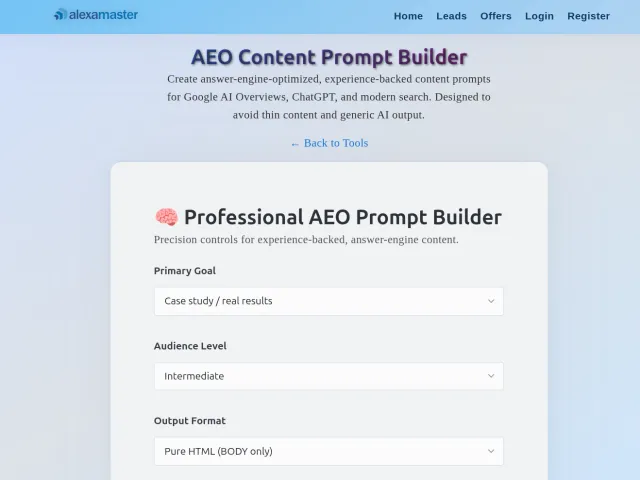
Helpful Tools: AEO Content Prompt Builder by Alexa Master Simple Free Non-AI Tools.